
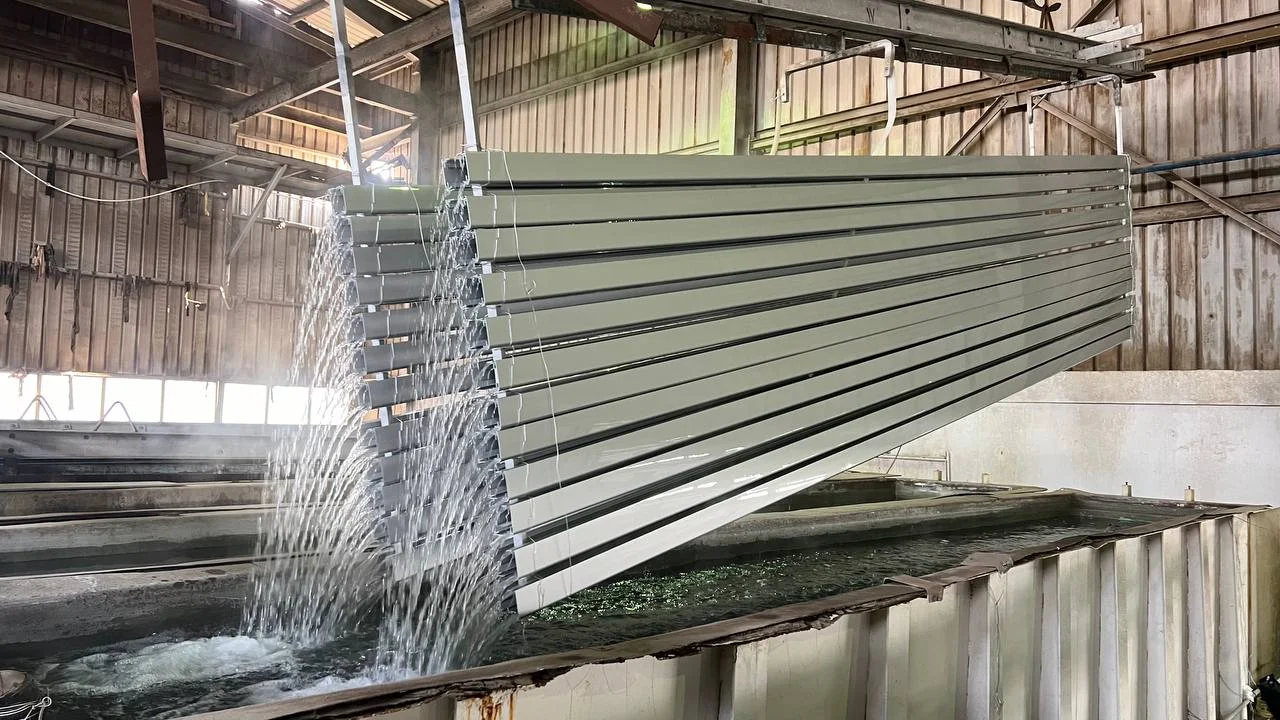
The properties of aluminum profiles differ substantially depending on Aluminum alloy Used. Alloys 6063, 6005, and 6061 are the most commonly used in the extrusion industry, although they look similar at first glance. In this guide, we'll explain the key differences between these alloys and how to choose the best one for your project.
Aluminum Alloy Grading System
Aluminum alloys are internationally classified by 4 digits (according to the American Aluminum Association system). The first digit indicates the main element alloyed with aluminum:
- Series 6xxx: Aluminum + Magnesium + Silicon (most commonly used in clouds)
- Series 1xxx: Pure Aluminum 99%+
- Series 7xxx: Aluminum + Zinc (for high-performance applications such as aerospace)
6xxx series alloys (6063, 6005, 6061) are the best for drawing because they combine good strength, ease of forming, and corrosion resistance.
Alloy 6063: The king of architectural applications
Slug 6063 It is the most commonly used globally in architectural profiles and is known as Architectural Alloy.
Characteristics:
- Medium tensile strength (215-260 MPa)
- Excellent retractability (allows for complex and thin designs)
- Excellent surface finish for anodizing and painting
- Very good wear resistance
- Easy welding and automation
Main uses:
- Building windows and doors
- Curtain Walls
- Furniture frames
- Pipes for stairs
- LED lighting profiles
If your project is a standard architectural project without significant structural loading, alloy 6063 is the ideal choice.
Alloy 6005: For stronger applications
Slug 6005 One of the best alloys for applications requiring higher strength than 6063 while retaining ease of forming.
Characteristics:
- Higher tensile strength (260-310 MPa)
- Good retractability (less flexible than 6063)
- Excellent corrosion resistance
- Good compatibility with welding
Main uses:
- Light Vehicle Chassis
- Sidewalks and pedestrian bridges
- Solar Mounting Systems
- Light Rail
- Large industrial ladders
Alloy 6061: Structural and structural applications
Slug 6061 It is the strongest in the 6xxx series and is considered a “Workhorse Alloy” for its versatility.
Characteristics:
- High tensile strength (290-310 MPa)
- Good configurability
- Good wear resistance
- Excellent compatibility with welding
- Good response to heat treatment
Main uses:
- Light Aircraft Structures
- Structural Aluminum Structures
- Heavy-duty wheel parts
- High-pressure pipes
- Ship parts
Comprehensive Comparison Table
| characteristic | 6063 | 6005 | 6061 |
|---|---|---|---|
| Tensile Strength (MPa) | 215-260 | 260-310 | 290-310 |
| Retractability | Excellent | Good | Medium |
| Surface finishing | Excellent | Good | Good |
| Corrosion resistance | Excellent | Excellent | Good |
| Welding | Good | Very good | Excellent |
| Cost | less | Medium | Top |
| Availability in Egypt | Very Wide | Wide | Relatively limited |
How do you choose the right alloy?
Instead of guessing, follow these steps:
1. Determine the expected loads: If light loads (less than 200 kg per meter) → 6063. Medium loads → 6005. Heavy or construction loads → 6061.
2. Study the environment: In marine environments, 6063 and 6005 are better than 6061 in corrosion resistance.
3. Let the design dictate: If the design is precise and requires very thin walls, only 6063 is capable of drawing with such precision.
4. Consult an engineering team: At Alumat, our engineering team helps you determine the ideal alloy for your project without over- or under-costing.
A common mistake: Avoid it
The biggest mistake new engineers make is Over-selecting an alloy that is too strong. Using 6061 alloy in an application that doesn't need it means:
- Increased cost (15-25%)
- Difficulty in pulling and producing thick walls
- Challenges with surface finishes
Choose the alloy that precisely meets the requirements, not the alloy that is “always the strongest”.
Conclusion
Choosing the right alloy isn't about choosing the “best”, it's about choosing the “best fit”. Alloy 6063 covers 80% for civil and architectural market applications, 6005 for stronger applications, and 6061 for critical structural applications.
At Alumat, we offer three types of alloys, and our engineering team is happy to help you select the best option for your project based on careful technical study.
 Arabic
  English
  German